Weather and Forecast Data via API: Which Providers Serve Energy Companies?
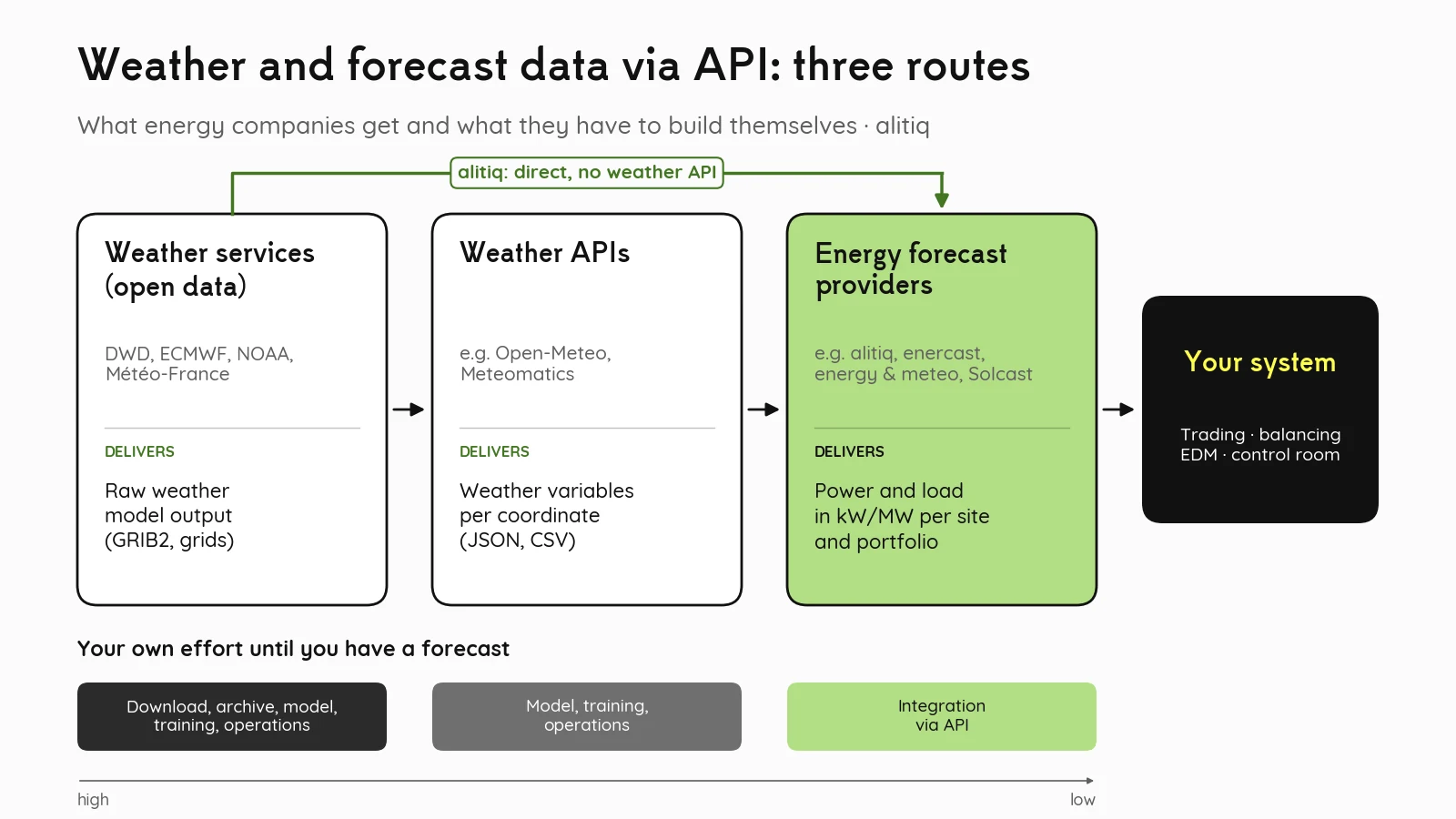
Three routes to weather and forecast data via API, and your own effort until you have a forecast
Energy companies get weather and forecast data via API from three sources: from national weather services such as DWD and ECMWF as open data, from weather API providers such as Open-Meteo or Meteomatics as processed weather variables, and from specialised energy forecast providers such as alitiq, enercast, energy & meteo systems or Solcast as ready-to-use power and load forecasts. Which one fits depends on what should arrive in your system: weather or megawatts.
Weather data or forecast data?
The two terms are often used interchangeably, but they mean different things:
- Weather data describes the atmosphere: global irradiance in W/m², wind speed at 100 metres, temperature, cloud cover.
- Forecast data in the energy sector describes your business: how much a PV plant or wind farm feeds in and how much your customers consume, in kW or MW.
In between sits a model that knows your sites and customers. If you buy weather data, you build and run that model yourself. If you buy forecast data, it comes included.
1. National weather services: open data
Every forecast starts with the numerical weather models of the weather services. Many of them are freely available today:
- Deutscher Wetterdienst (DWD): opendata.dwd.de hosts the ICON, ICON-EU and ICON-D2 models and the MOSMIX point forecasts. The data may be used commercially with attribution.
- ECMWF: Since 1 October 2025, the European Centre for Medium-Range Weather Forecasts has made its entire real-time catalogue open under CC BY 4.0. Delivering very large data volumes may involve service charges.
- Other services: NOAA with GFS, Météo-France with AROME and ARPEGE, the Danish DMI with HARMONIE.
Free does not mean effortless. The data comes as GRIB2 files on a grid, often several gigabytes per run. You have to download it, interpolate it to your sites and archive it, because the DWD open data server keeps older runs only briefly. Without your own archive, you later lack the history to train a model or test a forecast honestly.
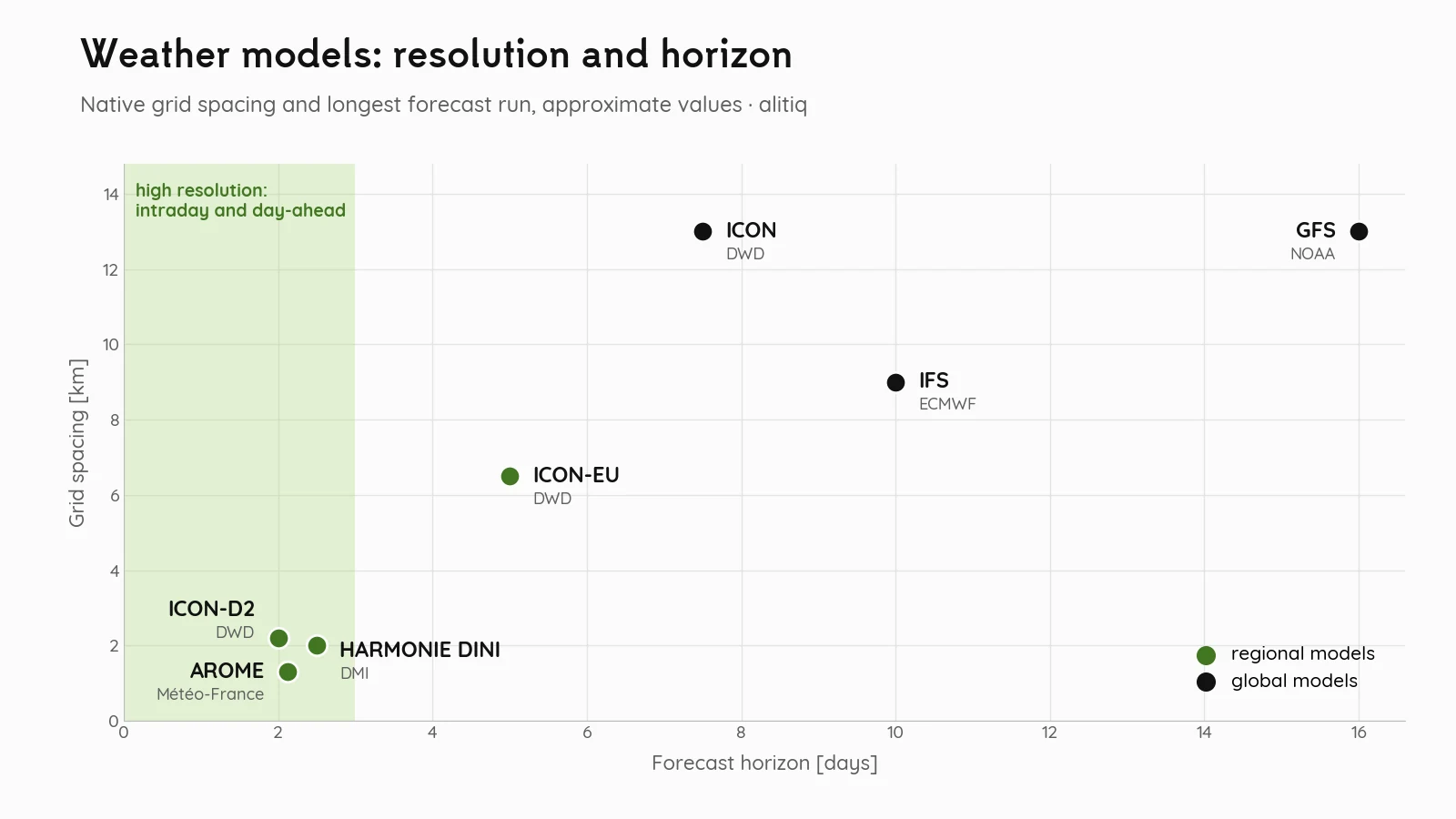
The chart shows why a single model is rarely enough. Regional models such as ICON-D2 or AROME run at about 1 to 2 km grid spacing and capture thunderstorms, fog and local wind fields well, but only look about two days ahead. Global models such as IFS or GFS reach 10 to 16 days, at a coarser grid. Intraday trading relies on the high-resolution models, procurement for the following days on the global ones.
2. Weather APIs: processed weather variables
Weather API providers take GRIB2 and grids off your hands. You query a coordinate and get a time series in JSON or CSV:
- Open-Meteo bundles the models of national weather services behind a simple REST API. It is free for non-commercial use, with a paid subscription for commercial use.
- Meteomatics from Switzerland offers, by its own account, more than 110 models plus historical and climate data, and explicitly targets energy companies.
A weather API is the right route if you need weather as an input to your own models, for example temperature for a heat demand forecast you build yourself. It does not take the step from weather to power or load: training, running and monitoring the model stay with you.
3. Energy forecast providers: ready-to-use power and load forecasts
Energy forecast providers deliver what trading, balancing and control rooms actually use: the expected feed-in or consumption per site and portfolio. They combine several weather models, retrain on your measurements and remove curtailments. Well-known providers in Europe and beyond include:
- alitiq: forecasts for solar PV, wind, load for electricity, gas and heat, and hydropower via a REST API and a Python SDK. We process the weather services' raw data directly, with no weather API in between.
- enercast: solar and wind forecasts via a REST web service, by its own account with up to ten weather models and horizons from 15 minutes to 31 days.
- energy & meteo systems: wind and solar power forecasts from Oldenburg, Germany, used internationally, including by the US grid operator MISO.
- Solcast: specialised in solar, with irradiance and PV power data worldwide, from 5 minutes to 14 days ahead.
The providers differ less in whether they offer an API than in what it covers: generation only or consumption too, forecasts only or historical runs too, one optimised result only or also the forecast per weather model.
The three routes compared
| Weather services (open data) | Weather APIs | Energy forecast providers | |
|---|---|---|---|
| Examples | DWD, ECMWF, NOAA | Open-Meteo, Meteomatics | alitiq, enercast, energy & meteo, Solcast |
| You get | Raw data on a grid | Weather variables per coordinate | Power and load per site and portfolio |
| Format | GRIB2 files | JSON, CSV via REST | JSON, CSV via REST, often file delivery too |
| Data cost | free | free to subscription | licence, usually per installed capacity |
| Own effort | high | medium | low |
| Fits | research, own weather pipeline | own forecast models | operational trading and balancing |
What to look for in a forecast API
Weather or power: an API is only as good as its details. These points matter day to day:
- Historical runs: Can you retrieve past forecasts per issue time? Only then can you test a forecast fairly, without later information leaking into the test.
- Unambiguous timestamps: the time zone in the timestamp and a clear rule whether it marks the start or end of the interval. Mistakes here cost real money in quarter-hour trading.
- Selectable weather model: besides the optimised result, the forecast per weather model, for your own analyses and as a fallback.
- Portfolio and single site: both queries, ideally with a portfolio total.
- Feedback channel: push measurements and curtailments via API so the model learns.
- Units and resolution: kW or MW, 15, 30 or 60 minutes, freely selectable.
- Documentation, SDK and trial access: if you cannot test before signing, you are buying blind.
More criteria for choosing a provider and a build-or-buy calculation are in our article How to choose a forecasting provider.
How it works at alitiq
We take the direct route: we download and process the model data from DWD, ECMWF, NOAA, Météo-France, DMI and other weather services ourselves and skip third-party weather APIs. Behind this is a team with deep meteorological experience. We know which model is strong in which weather situation, how to bring irradiance and hub-height wind cleanly to a site, and where weather models are systematically off. That way we control the whole chain from weather model to megawatt forecast, archive every run for fair backtests and react quickly when a weather service changes a model.
Our forecasts run operationally on our side. You register your sites via API or in the API portal and query the forecast, for example with our Python SDK:
from alitiq import alitiqSolarAPI
from alitiq.enumerations.forecast_models import ForecastModels

solar_api = alitiqSolarAPI(api_key="your-api-key")

forecast = solar_api.get_forecast(
    location_id="PV-001",
    forecast_model=ForecastModels.ICON_D2,
    power_measure="MW",
    timezone="Europe/Berlin",
)
You get back a pandas DataFrame. Without forecast_model you receive our optimised forecast from several weather models; with it, the forecast based on a single model such as ICON-D2, ICON-EU, HARMONIE DINI or GFS. The same data is available without code as JSON or CSV via the REST API. We also provide weather forecasts from several models through our weather API.
Frequently asked questions
Is DWD weather data free?
Yes. The model data on opendata.dwd.de is free and may be used commercially with attribution. The effort lies in downloading, processing and archiving it.
Is a weather API enough for direct marketing?
Only if you run your own model that converts weather into power and retrains on your measurements. Otherwise an energy forecast provider is the shorter route.
What does a power forecast via API cost?
Most providers charge per installed capacity. At alitiq it is EUR 18 per MW and month for solar and wind, and you can test for 30 days free of charge.
What we take from it
- Three sources: weather services deliver raw data, weather APIs weather variables, forecast providers megawatts.
- Free is relative: open data saves licence fees but shifts effort into pipeline, archive and model operations.
- Details decide: historical runs, clean timestamps, choice of weather model and a feedback channel for measurements.
If you want to get weather and forecast data for your portfolio via API, talk to us. We will set up a trial account and are happy to compare against your current system.
Ready to Transform Your Business?
Discover how alitiq's forecasting intelligence can optimize your operations.
Contact Us